Loading the homepage
Blog/Tutorials
n8n TikTok automation in 2026.
You can wire ideation, image generation, and publishing into one n8n workflow. The nodes are the easy part. The wall is TikTok's Content Posting API audit, and a six-requests-per-minute ceiling the tutorials skip.
MT
Matt Torres
Founder, Deeporax
Reviewed by Rhea Park, TikTok growth lead
Published Jul 25, 202618 min read · fact-checked
Key takeaways
- n8n can absolutely run the creative half of a TikTok slideshow pipeline: trigger, idea, caption, images, assembly. That part usually takes an afternoon and works well.
- The publishing half is where builds die. TikTok's Content Posting API forces every post from an unaudited app to SELF_ONLY private, requires you to verify ownership of the domain your images are served from, and caps you at six requests per minute per account.
- Cash cost is low (roughly $30 to $45 a month for a three-post-a-day account). Time cost is not: expect 10 to 25 hours to first working post, then recurring maintenance every time a node, model, or API version moves.
What n8n TikTok automation actually means.
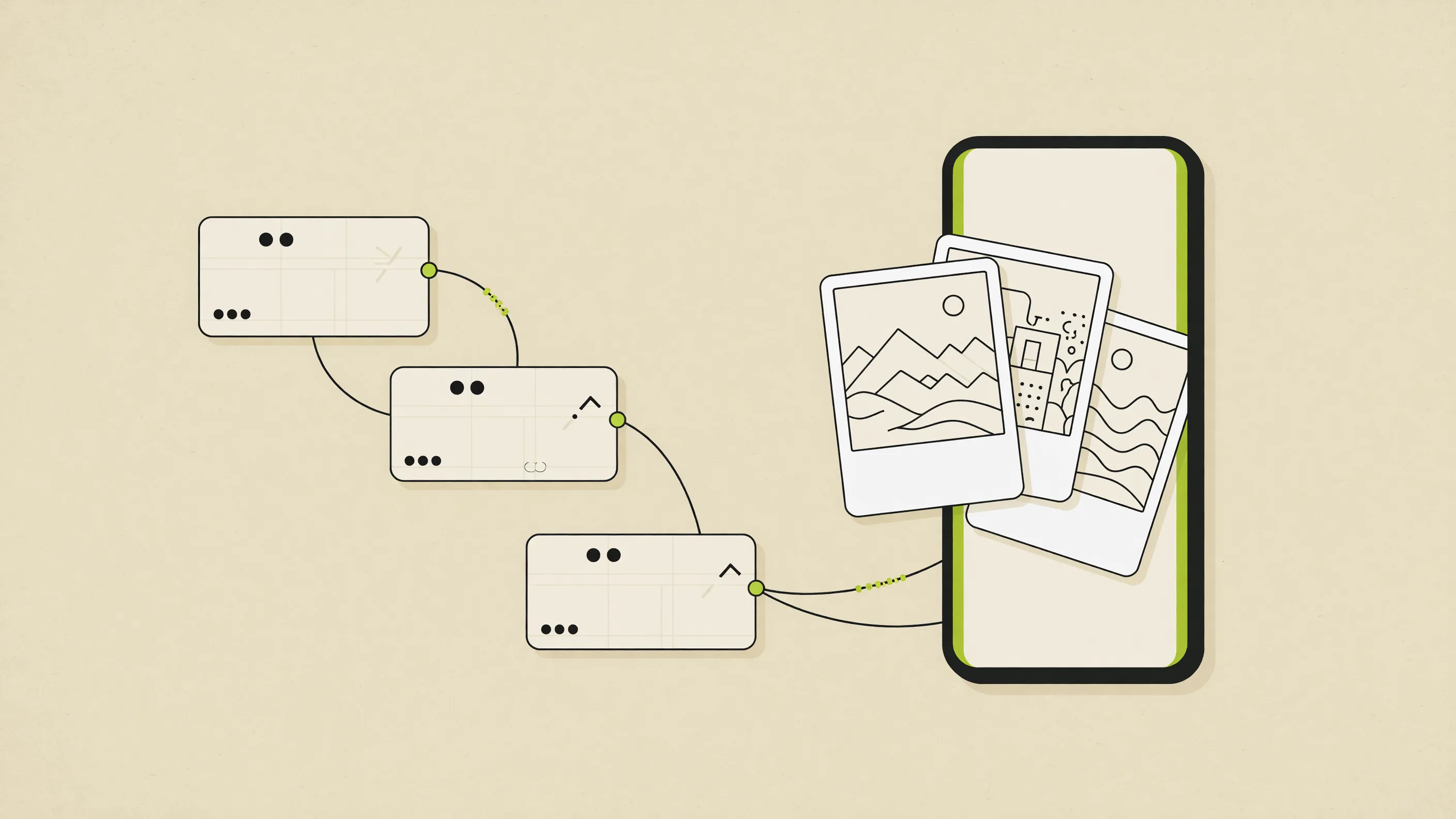
n8n TikTok automation means using n8n, the open-source workflow automation tool, to chain together the steps of producing and publishing a TikTok post without touching them by hand. For slideshows specifically, that chain is: pick a topic, write the slide copy and caption, generate or fetch the images, assemble them in order, and hand the finished set to TikTok's Content Posting API on a schedule. Each step is one node on a canvas, wired to the next.
That description makes it sound settled, and for five of those six steps it is. The creative half of the pipeline is genuinely straightforward in n8n, and you can have it running the same day you start. The publishing step is the one that turns a two-hour project into a two-week one, because TikTok's posting API is not a normal REST endpoint you point at and forget. It has an approval process, a domain verification requirement, a visibility restriction that silently makes every post private until you pass an audit, and a rate limit low enough to matter.
This guide walks the whole build, node by node, then spends most of its length on the parts that break: the API audit, the cost math nobody publishes, and the maintenance load that shows up in month two. I have built this pipeline three times and retired it three times. The verdict at the end is not a sales pitch against n8n, which is an excellent tool. It is a specific argument about which layer of the stack is worth owning yourself. If you want the shorter, non-technical version of the same workflow, how to automate TikTok slideshows with AI covers the concepts without the API plumbing.
Why this question got loud in 2026.
Two things happened at once. n8n got very big, and AI image generation got very cheap. n8n raised a $180 million Series C led by Accel in October 2025 at a $2.5 billion valuation, then took a strategic investment from SAP that lifted the valuation to $5.2 billion. The platform reports around 230,000 active users, a 141 percent increase over the prior year, and says more than 80 percent of workflows built on it now involve AI agents rather than plain if-this-then-that logic.
That growth pulled a large population of non-engineers onto a node canvas for the first time, and the first thing many of them tried to automate was social posting. Search the faceless-content corner of X right now and the dominant thread is exactly this: multi-agent n8n setups handling ideation, scripting, image synthesis, and publishing for TikTok and YouTube at scale. n8n's own template library has ready-made entries for uploading image carousels to TikTok and Instagram, and for generating carousels with an image model and publishing them, which is why the idea feels like a solved problem before you open the editor.
Meanwhile the input costs collapsed. Image generation APIs in mid-2026 span roughly $0.005 to $0.20 per image depending on model and tier, with the practical middle sitting around $0.01 to $0.05. At those prices an eight-slide post costs cents, which changes the arithmetic of posting three times a day forever. So the question is no longer whether you can afford to generate the content. It is whether you can afford the engineering around it.
Here is the part that surprises people: n8n has no official TikTok node. As of 2026 the TikTok integration link on n8n's own site leads nowhere, so there is nothing to drag onto the canvas and authenticate. What exists instead is a handful of community-built packages, some of which carry explicit work-in-progress and not-working-yet disclaimers in their own repositories. n8n Cloud now supports installing community nodes from inside the editor, which helps, but you are still depending on a volunteer package to stay current with a platform API that changes without warning. That single missing node is the reason most of this guide is about the posting layer rather than the creative one.
The pipeline, node by node.
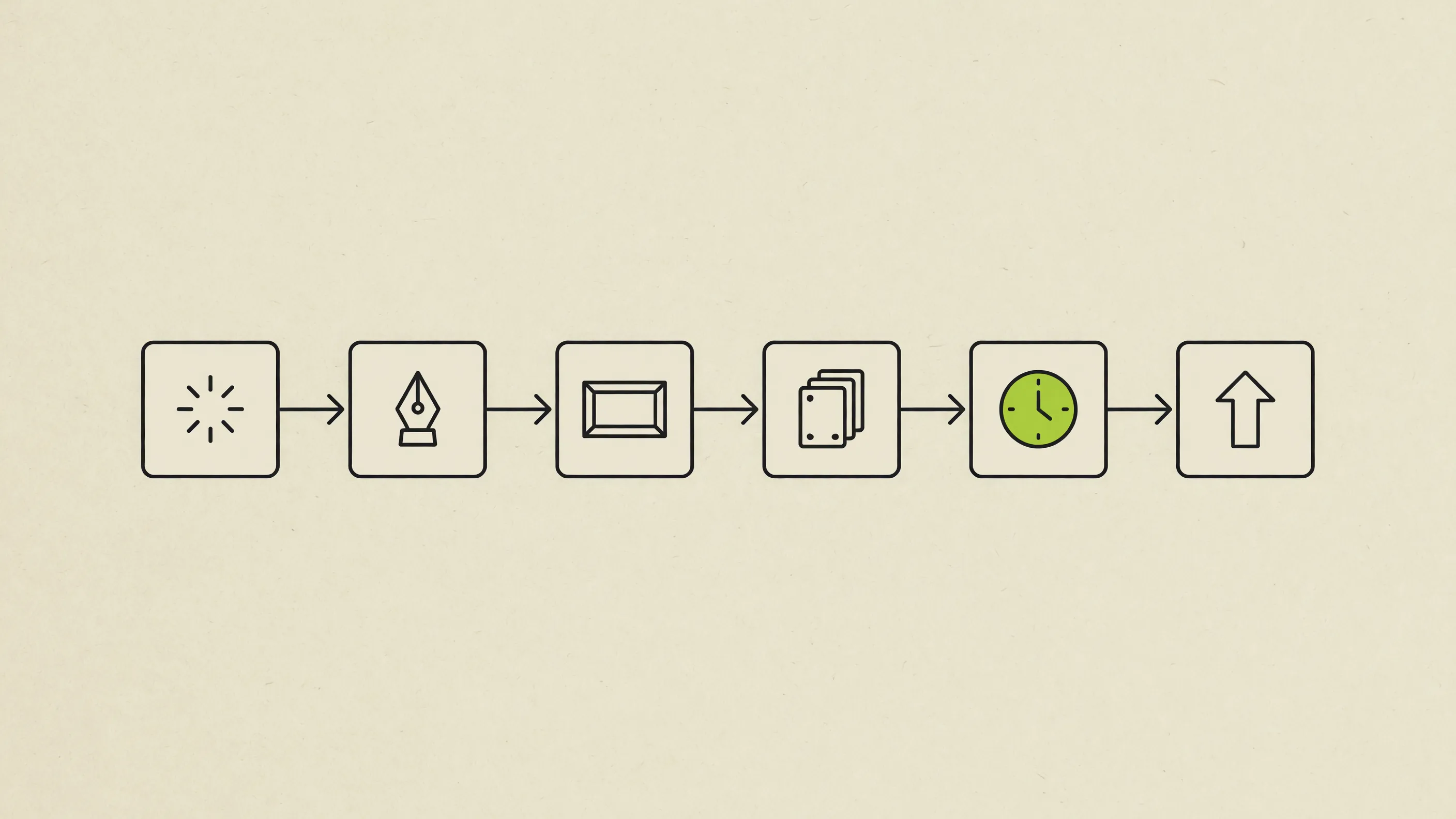
A working slideshow pipeline has six stages. Five of them are ordinary n8n work that behaves the way you expect. Here is the full shape before we get into the one that does not.
| Stage | What the node does | Difficulty |
|---|---|---|
| 1. Trigger | Schedule node fires at your posting times, or a webhook fires when a row lands in a sheet or database | Easy |
| 2. Topic selection | Pull the next unused idea from a sheet, Airtable, or Postgres table; or call an LLM to generate one against your niche brief | Easy |
| 3. Copywriting | LLM node writes the hook slide, the body slides, and the caption. Enforce a JSON schema so downstream nodes get predictable fields | Moderate |
| 4. Image generation | Loop over slides, call an image API per slide, store each result somewhere with a stable public URL | Moderate |
| 5. Assembly | Order the URLs, attach the caption, apply your hashtag rules, write the whole thing to a queue row | Easy |
| 6. Publish | Hand the ordered photo URLs and caption to TikTok's Content Posting API and handle the response | Hard |
Structure reflects the shape used by n8n's own TikTok and Instagram carousel templates (see Sources below).
Stage 3 deserves a note, because it is where most first builds produce garbage that looks fine in the n8n execution log. An LLM node asked to "write a slideshow about X" will happily return prose, and prose does not fit on a slide. Constrain it: return an array of exactly N strings, each under a character ceiling you have actually measured against your template, plus a separate caption field and a separate hashtag array. Then validate the shape in a Code node and fail loudly when it does not match, rather than letting a malformed object flow into image generation and burn API credits on slides you will throw away.
Stage 4 has a subtler trap. Slides generated independently drift. Slide one comes back with a warm palette and a centered subject, slide four comes back cool and off-center, and the finished set looks like four different accounts made it. The fix that works is passing a reference image plus a fixed style clause into every call in the loop, so the subject and treatment stay locked across the set. Some of the more polished community templates do exactly this: drop in one reference image, set a topic and a slide count, and let the workflow generate the rest against that anchor. Without it you get technically-correct output that reads as inconsistent to a human scrolling.
Stage 5 is worth doing as a real queue rather than a direct handoff to stage 6, even though it feels like unnecessary indirection at first. Writing the assembled post to a row with a status column means a failed publish does not destroy the creative work. You retry the publish, not the whole generation. Given that TikTok's posting API is the least reliable link in the chain, that separation pays for itself in the first week. It also gives you somewhere to eyeball output before it goes live, which matters more than most people expect the first time an LLM writes something you would not want on your account.
The wall: TikTok's Content Posting API.
Everything above is a normal Tuesday. This is the part that stops builds. TikTok's Content Posting API supports photo posts, so slideshows are genuinely publishable by API, but the requirements around it are unusually strict and they are not obvious until you are already deep in the build.
Start with the restriction that wastes the most time. Until your API client passes TikTok's audit, every piece of content it posts is forced to SELF_ONLY, which means private, visible to nobody but the connected account. The accounts posting through an unaudited client must themselves be set to private at the time of posting, and an unaudited client can serve at most five users in any 24 hour window. So your pipeline can run perfectly, log a 200, produce a real post ID, and publish something the world cannot see. To make those posts public afterward you have to switch the account to public and then change the privacy setting on each post by hand, which defeats the entire point of the automation.
The first time I built this, everything returned success for four days straight. I only found out the posts were private because a friend told me my page looked empty.
Rhea Park, TikTok growth lead, Deeporax
The second requirement is the one that quietly breaks stage 4. Photo posts go through the content publish endpoint with media_type set to PHOTO, and the only supported source is PULL_FROM_URL. There is no file upload path for photos the way there is for video. TikTok fetches each image from a URL you provide, and those URLs have to be publicly reachable and served from a domain whose ownership your app has verified with TikTok. That rules out signed temporary URLs, most object-storage default hostnames you do not control, and anything behind auth. You need a real domain, verified, with your generated slides sitting on it publicly. Plenty of tutorials skip this and their readers hit an opaque fetch failure with no idea why.
| Constraint | The actual limit | What it means for your build |
|---|---|---|
| Client audit | Unaudited clients post SELF_ONLY only, max 5 users per 24h | Nothing is publicly visible until you pass review. Budget for the wait before you promise anyone a launch date |
| Image source | PULL_FROM_URL only for photos, no direct file upload | You must host slides at public URLs. Signed or expiring URLs will not work |
| Domain verification | You must verify ownership of the URL prefix or domain | A domain you control is a hard prerequisite, not a nice-to-have |
| Photos per post | Up to 35 | Not a real constraint for slideshows; typical sets run 6 to 12 slides |
| Title length | 90 UTF-16 runes for photo posts | Shorter than most people assume. Validate before you send or the call fails |
| Description length | 4,000 UTF-16 runes | Generous. Your caption and hashtags fit comfortably |
| Rate limit | 6 requests per minute per user access token, rolling window | Fine for one account. A ceiling the moment you run several from one workflow |
| Required scope | video.publish for direct post, video.upload for draft handoff | Request the right one during OAuth or you get a permissions error at publish time |
Source: TikTok for Developers Content Posting API reference and content sharing guidelines, plus 2026 rate-limit documentation (see Sources below).
The six-requests-per-minute limit sounds generous until you look at what counts as a request. Initialising a post, checking its publish status, and any retry all draw from the same rolling bucket, per user token. One account posting three times a day never notices. Ten accounts driven from a single workflow, each with its own token, means ten separate buckets you now have to track and back off against independently, and n8n's default behaviour on an HTTP error is not a well-mannered exponential backoff unless you build one. This is the point where a hobby workflow becomes a distributed systems problem, and it arrives earlier than people expect.
There is a legitimate escape hatch worth naming. Instead of running your own audited TikTok client, you can route publishing through a third-party posting API that has already done the audit and maintains the integration. Several of these exist with official n8n integrations, and pricing starts around $16 a month with usable free tiers. You trade a per-month fee and a dependency for skipping the audit, the domain verification, and the maintenance. For most solo creators that is a straightforwardly good trade, and it is the option I would pick if I were determined to keep the pipeline in n8n.
One more thing that is not an API limit but will end you faster than any of them. TikTok's Community Guidelines treat using automation to register or operate accounts in bulk as platform manipulation, and automation built to bypass platform systems can lead to content removal or account bans. Publishing your own content to your own account through the official API is exactly what the API is for and is not the problem. Spinning up twenty accounts from one workflow to blanket a niche is the problem, and no amount of clean n8n architecture makes it safe. If you are unsure where the line sits for AI-generated slides specifically, will TikTok flag your AI slideshows covers the labelling side in detail.
What it actually costs to run.
Almost every n8n tutorial ends at "and it's basically free." That is true of the software and false of the system. Here is the arithmetic for a realistic single-account setup posting three slideshows a day, eight slides each, which is 90 posts and 720 generated images a month.
| Line item | Monthly cost | Notes |
|---|---|---|
| n8n Community Edition licence | $0 | Free software, unlimited executions when self-hosted |
| Server to run it on | $4 to $12 | Small VPS, or roughly $4 to $7 on a managed n8n host |
| Image generation (720 images) | $7 to $36 | At $0.01 to $0.05 per image depending on model tier |
| LLM calls (copy for 90 posts) | $1 to $4 | Small prompts, cheap model; negligible at this volume |
| Image hosting on a verified domain | $1 to $5 | Object storage plus a domain you already own |
| Third-party posting API (optional) | $0 to $16 | Skip it only if you run your own audited client |
| Total cash | $13 to $73 | Realistic middle is around $30 to $45 |
| Your time, first build | 10 to 25 hours | The line item that decides whether this was worth it |
Cost inputs: 2026 n8n self-hosting price surveys, published image-generation API rate cards, and third-party posting API pricing pages (see Sources below).

Thirty to forty-five dollars a month is genuinely cheap for 90 posts. If cash were the only axis, self-hosting would win outright and this guide would end here. The distortion is the last row. Ten to twenty-five hours is my honest range across three builds, and it assumes you are comfortable with OAuth flows, JSON schemas, and reading API error responses. The first build took me closer to thirty because I spent most of a week not understanding that my posts were succeeding and staying private.
The self-hosting line also hides work. A four-dollar VPS is four dollars of hardware and an unbounded amount of ownership: Docker, a Postgres or SQLite decision, a reverse proxy, TLS renewal, version upgrades, backups, monitoring, and security patches. None of it is hard. All of it is yours, forever, on a machine whose only job is posting slideshows. Managed n8n hosting removes most of that for a couple of dollars more and is the option I would take without hesitating.
Where these workflows break in month two.
A pipeline that works on day one and a pipeline that works in week nine are different artifacts. The failures are boringly predictable, which at least means you can plan for them.
Community node rot is first. Because there is no official TikTok node, you are on a package maintained by someone with no obligation to you. When TikTok changes a field or deprecates a parameter, the package updates when its maintainer has a free evening. Some of the available packages advertise their incomplete state openly in their own repositories, which is honest and also exactly the risk. Your posting stops, silently, and you find out from your analytics rather than from an alert.
Token expiry is second and catches everyone once. OAuth refresh tokens for the posting API do not live forever. When one lapses, the publish node starts returning auth errors and the workflow keeps cheerfully executing, marking rows as attempted, generating images, and dropping them into the void. Build a real check: assert on the publish response, write the failure to a status column, and send yourself a message. A workflow that fails loudly is worth more than one that fails elegantly.
Model drift is third and the least discussed. Image and language models get deprecated, renamed, and retuned on the provider's schedule. A prompt that produced clean, consistent slides in May produces subtly different framing in August, because the model behind the same endpoint moved. Nothing errors. The output just gets worse in a way you notice a month later when engagement has drifted down and you cannot tell why. Pin model versions where the provider allows it, and keep a small set of reference outputs you can eyeball against.
Fourth is the one people find hardest to accept: the creative layer needs more human attention than the technical layer, not less. Automating publishing does not automate judgment. An account posting three fully-automated slideshows a day with no one reading them will drift into repetitive, low-signal output, and TikTok's distribution will reflect that long before you notice the pattern yourself. The accounts that do well on automated pipelines all have a human doing a five-minute review pass, checking the hook, and killing the occasional post. If you want the hook side handled properly, our list of 100+ slideshow hook ideas is a better input than asking a model to invent one from nothing each time.
Fifth, and specific to new accounts: a brand-new page that starts posting three times a day from an API on day one looks nothing like a real creator ramping up. Posting cadence is part of how an account establishes itself, and a cold account fed by a pipeline at full volume is a common reason a technically-perfect build produces zero views. That is a separate problem from the automation working, and how to warm up a TikTok account covers the ramp that should come first.
Build it or buy it: an honest call.
I run a product that competes with the thing I am about to describe, so read this with that in mind. My actual position is narrower than "don't build it," and it is this: n8n is the right tool for the parts of your pipeline that are specific to you, and the wrong place to own a platform posting integration.
| If this is you | Do this |
|---|---|
| You already run n8n, enjoy the plumbing, and want total control of the creative logic | Build it. Use a third-party posting API for the publish node so you skip the audit and the domain verification |
| You have unusual creative requirements: a proprietary data source, a specific brand pipeline, a niche nobody's tool covers | Build it. That specificity is exactly what a workflow tool is for, and no product will match it |
| You want posts going out this week and you are not an engineer | Buy it. The 10 to 25 hours is the real price, and it is charged in your time before you see a single view |
| You are running more than a handful of accounts | Buy it. Per-token rate limits, per-account auth, and per-account audit status compound faster than the workflow scales |
| You want to learn how the pieces fit together | Build it once, deliberately, on a throwaway account. It is a genuinely good education even if you retire it after |
The reason the posting layer is a bad thing to own is that it gives you zero differentiation for permanent maintenance cost. Nobody watches your slideshow because of how it was uploaded. Every hour you spend on OAuth refresh handling and rate-limit backoff is an hour not spent on the hook, the niche, or the offer, which are the only three things that actually move the numbers. Meanwhile the maintenance never ends, because the API is not yours and it will keep moving.
The creative layer is the opposite. If you have a real edge, a data source nobody else has, a way of framing a niche, a template that converts, then that edge lives in stages 2 through 5, and n8n is a fine place to keep it. The hybrid that makes the most sense is: keep the creative logic in n8n where you can change it freely, and let something else own the audited posting integration. That is the architecture I would build today if I were starting over. If you would rather compare the finished products before deciding, best AI TikTok slideshow generators in 2026 is the honest comparison, including where we lose.
What we see across accounts running automated pipelines.
These are aggregate patterns from accounts in our own user base and from builders who moved off a self-hosted pipeline onto our tool, not single named case studies. Individual results vary heavily by niche, account age, and how much human review sits on top. I am describing the shape of what happens, not promising a number.
The most consistent pattern is the abandonment curve. Builders who wire the whole thing themselves, posting layer included, tend to get to a first working post in one to three weeks, then hit a maintenance event in the first two months: a token expiring, a community node breaking, a model deprecating. Roughly half do not repair it. Not because the fix was hard, but because the fix arrived during a week when they had other work, and by the time they came back the pipeline had been dark for long enough that restarting the account felt like more effort than the account was worth. The pipeline was never the fragile part. Attention was.
The second pattern is more encouraging and shows up in the hybrid setups. Accounts that kept idea selection and copywriting in n8n but handed publishing to something already audited hit their first live post in days rather than weeks, and stayed running, because the thing most likely to break was no longer theirs to fix. The n8n half of those builds barely changes after the first week. It does not need to. Trigger, sheet, LLM, image loop, queue: that logic is stable because none of its dependencies are a social platform's publishing API.
The third pattern is a caution about volume. Accounts that used automation to go from three posts a week to three a day usually saw total views rise, which is the expected result. Accounts that pushed from three a day to ten mostly did not, and several went backwards. More posts through the same pipeline means more near-identical output, and repetition is one of the clearest signals of a page that is not worth distributing. Automation removes the labour ceiling on posting, and it turns out the labour ceiling was doing useful work by forcing you to care about each post. If reach rather than volume is the goal, TikTok SEO for slideshows is a better lever than posting frequency.
Common questions.
Can n8n post to TikTok automatically?+
Yes, but not out of the box. n8n has no official TikTok node in 2026, so you either use a community-built package, call TikTok's Content Posting API directly from an HTTP Request node, or route publishing through a third-party posting API that has an official n8n integration. All three work. The direct route requires you to register an app with TikTok, verify a domain, and pass an audit before anything you post is publicly visible.
Is there an official n8n TikTok node?+
No. As of 2026 the TikTok integration link on n8n's own site leads nowhere, and what exists instead is a set of community packages, some of which state openly in their repositories that they are incomplete. n8n Cloud does let you install community nodes from inside the editor, which lowers the friction, but you are still relying on a volunteer-maintained package to keep pace with a platform API that changes without notice.
Does TikTok's API support slideshows and photo carousels?+
Yes. The Content Posting API accepts photo posts through the content publish endpoint with media_type set to PHOTO, and a single post can carry up to 35 photos. Slideshows are a first-class content type here, not a workaround. The catch is that photos support only PULL_FROM_URL as a source, so TikTok fetches each image from a public URL you host rather than accepting a file upload.
Is automating TikTok posts against the rules?+
Publishing your own content to your own account through TikTok's official API is exactly what the API exists for, and it is not a violation. What TikTok's Community Guidelines prohibit is platform manipulation, which explicitly includes using automation to register or operate accounts in bulk, along with automation designed to bypass platform systems. The distinction is between automating your own publishing and operating a network of accounts.
Is n8n free for this?+
The Community Edition software is free with unlimited executions when you self-host, but the system around it is not. Expect $4 to $12 a month for a small VPS, or roughly $4 to $7 on a managed n8n host, plus your image generation and LLM API spend. For a three-post-a-day account the realistic all-in cash figure lands around $30 to $45 a month.
How do I set up the TikTok Content Posting API in n8n?+
Register a developer app with TikTok, request the video.publish scope for direct posting (video.upload if you only want to hand drafts to the user), complete OAuth to get a user access token, verify ownership of the domain your slide images will be served from, then call the content publish init endpoint from an HTTP Request node with media_type PHOTO and your ordered image URLs. Submit the client for audit before you expect anything to be publicly visible.
Why are my API-posted slideshows private or invisible?+
Almost certainly because your API client has not passed TikTok's audit. Every post from an unaudited client is forced to SELF_ONLY viewership, and the posting account must be private at the time of posting. The API returns success and a real post ID, so nothing in your logs looks wrong. Passing the audit lifts the restriction; until then, making a post public means switching the account to public and changing each post's privacy by hand.
How many images can one TikTok slideshow have via the API?+
Up to 35 photo URLs in a single post. That ceiling is far above what performs well, so treat it as a technical limit rather than a target. Most slideshows that hold attention run somewhere between 6 and 12 slides, with the hook doing most of the work on slide one and the payoff landing before people lose patience swiping.
What are the TikTok API rate limits I need to design around?+
Six requests per minute per user access token for the Content Posting API, on a rolling one-minute window rather than a fixed reset. Post initialisation, status polling, and retries all draw from the same bucket. One account posting a few times a day will never touch it. Several accounts driven from one workflow means several independent buckets to track, and you will need real backoff logic rather than n8n's default error behaviour.
How do I keep AI-generated slides looking consistent across a set?+
Pass a reference image plus a fixed style clause into every image call in the loop, rather than generating each slide from a fresh prompt. Without an anchor, independently generated slides drift in palette, framing, and subject treatment, and the finished set reads as though several accounts made it. Some community carousel templates do this by design: you supply one reference image and a slide count, and the workflow generates the rest against that anchor.
My publish node returns an error about the image URL. What's wrong?+
The most common cause is that your image URLs are not served from a domain whose ownership you have verified with TikTok. Photo posts pull from URLs, and those URLs must be publicly reachable and on a verified URL prefix or domain. Signed or expiring links, storage hostnames you do not control, and anything behind authentication will all fail, usually with an error message that does not name the real cause.
The workflow runs successfully but nothing appears on my account. Why?+
Check three things in order. First, audit status, since unaudited clients post privately and still return success. Second, your OAuth token, because an expired refresh token produces auth errors that a workflow without response assertions will happily execute past. Third, whether your publish step is actually reading the publish response at all: many builds mark a row as posted based on the node completing rather than on TikTok confirming the post.
My automated posts get zero views. Is the pipeline broken?+
Usually not. A brand-new account that starts posting three times a day from an API on day one does not resemble a real creator ramping up, and cold accounts commonly sit near zero views regardless of how clean the automation is. Warm the account first with a slower, manual cadence, then hand it to the pipeline. Verify separately that your posts are actually public, since the audit restriction produces the same symptom.
How much maintenance should I expect after the build works?+
Plan for a breaking event within the first two months. The usual culprits are a lapsed OAuth refresh token, a community node falling behind an API change, or an image or language model being deprecated or retuned under the same endpoint. None of these are hard fixes individually. The pattern we see is that they arrive during a busy week, the pipeline goes dark, and a meaningful share of builders never restart it.
Should I build this in n8n or use a dedicated tool?+
Keep the creative logic in n8n and do not own the posting integration. Stages like idea selection, copywriting, and image generation are where your actual edge lives and where a workflow tool earns its keep. The publish step gives you no differentiation for permanent maintenance cost, so route it through something already audited, whether that is a third-party posting API or a product that handles the whole publishing layer. If you want posts live this week and you are not an engineer, buy the whole thing.
Sources.
- TikTok for Developers, Content Posting API reference: photo post (endpoint, 35-photo limit, PULL_FROM_URL, domain verification, 90-rune title)
- TikTok for Developers, Content sharing guidelines (unaudited clients restricted to SELF_ONLY, 5 users per 24 hours)
- TikTok for Developers, Guide to using the Content Posting API
- TikTok for Developers, Understanding TikTok API rate limits (6 requests per minute per user access token)
- TikTok Community Guidelines, Integrity and authenticity (platform manipulation, operating accounts in bulk)
- n8n, Upload carousel of images to TikTok and Instagram (workflow template)
- n8n, Generate and publish carousels for TikTok and Instagram with GPT-Image-1 (workflow template)
- TechFundingNews, SAP backs n8n at $5.2B valuation
- Ventureburn, n8n secures $180 million Series C at a $2.5 billion valuation
- Startup Riders, How n8n grew to $100M+ ARR and a $5.2B valuation (230,000 active users, +141% YoY, 80%+ of workflows using AI agents)
- eesel AI, A practical guide to TikTok integrations with n8n (no official node, broken integration link)
- npm, n8n-nodes-tiktok community package
- GitHub, igabm/n8n-nodes-tiktok (community node, work-in-progress disclaimer)
- alternativeto.net, n8n Cloud now supports community-built nodes with in-editor installation
- Sliplane, n8n pricing in 2026: cloud, self-hosting, and managed hosting
- DEV Community, The cheapest way to self-host n8n in 2026
- BuildMVPFast, AI image generation API pricing, July 2026
- Digital Applied, AI image generation API pricing: 12 providers compared (2026)
- Phyllo, TikTok API rate limits in 2026: quotas, errors and workarounds
- Phyllo, TikTok API integration guide 2026: setup, endpoints, common pitfalls
- PostPeer, TikTok Content Posting API in 2026: direct post, audit, and alternatives
- Upload-Post, n8n integration guide and pricing
- Deeporax internal build notes on three self-hosted n8n posting pipelines, 2025 to 2026
- Deeporax aggregate account data on builders migrating from self-hosted pipelines (2026)
MT
Written by
Matt Torres
Founder of Deeporax. Ran faceless TikTok pages for years before building the tool. Built and then retired three separate n8n posting pipelines before deciding the posting layer was the wrong thing to own.