Loading the homepage
Blog/Strategy
Does TikTok pay for slideshows in 2026?
TikTok's Creator Rewards Program doesn't pay for slideshows, only video. Here's exactly how faceless slideshow pages make money instead, and how much.
Deeporax Team
The Deeporax team
Reviewed by Rhea Park, TikTok growth lead
Published Jul 24, 202620 min read · fact-checked
Key takeaways
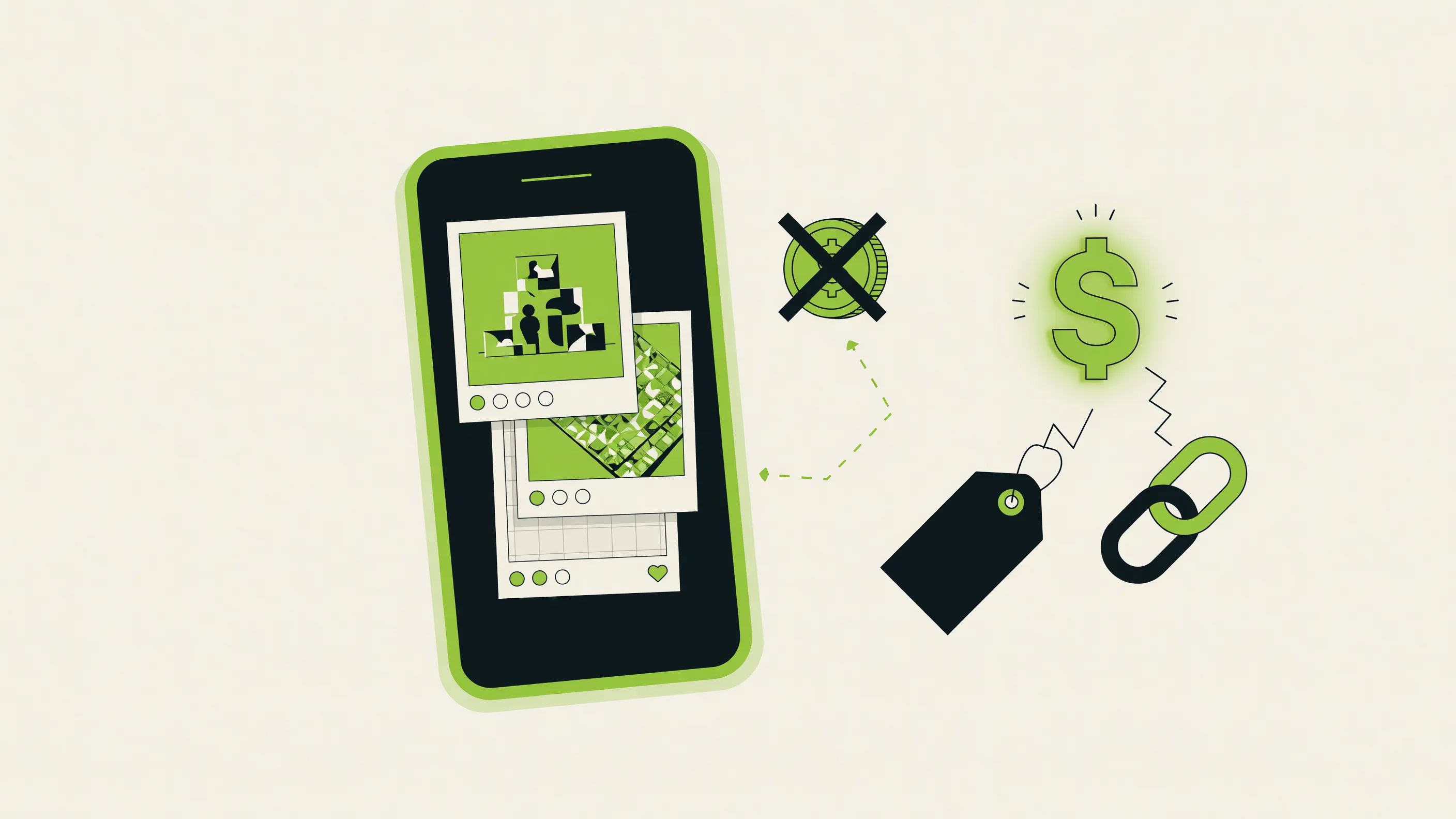
- TikTok's Creator Rewards Program only pays for original video over one minute long, not Photo Mode or slideshow posts.
- Slideshows earn instead through TikTok Shop affiliate commissions, brand deals, and off-platform funnels.
- The highest-earning faceless pages usually run at least two of those channels at once, not just one.
The short answer, and why so many creators get it wrong.
No, TikTok's Creator Rewards Program does not pay for Photo Mode or slideshow posts. Only original videos longer than one minute, with at least 1,000 views on the For You feed, are eligible for a payout. Slideshows still make money on TikTok, just not through that program. The income comes from TikTok Shop affiliate links, brand deals, and traffic sent off the app.
This confusion is common enough that TikTok's own search bar surfaces it constantly. Type in almost any variation, do photos qualify for Creator Fund, can I make a slideshow for the Creator Reward Program, does Creator Fund work with slideshows, and you'll find a cluster of near-identical Discover pages, evidence that a lot of creators genuinely don't know the answer. The confusion has a real cause: TikTok pushed Photo Mode hard through 2022 and 2023, slideshows started pulling FYP reach that rivaled video, and creators reasonably assumed the algorithm's generosity extended to the reward programs too. It never did.
TikTok's own eligibility documentation is direct about the carve-out. The Creator Rewards Program terms require original User Content with a duration of at least one minute, and the program's quality guidelines separately name Photo Mode and slide-style posts as content that does not meet the bar for rewards, regardless of view count (TikTok Creator Academy, 2026). There isn't a workaround written into the rules; the exclusion is structural, not a bug someone forgot to patch.
For a page running slideshows today, the practical move is simple: open your own Creator Rewards Program tab and you'll likely see it isn't even evaluating your slideshow posts as candidate content. That's expected, not an error. The useful next step isn't waiting for that to change, it's redirecting the same energy toward the monetization paths that are actually open to slideshow format content, which the rest of this guide covers in detail.
One mistake worth naming early: some creators try exporting a slideshow as an MP4, effectively wrapping static images in a video file, hoping it slips into the video-eligible bucket. TikTok's originality policy is built specifically to catch this. A 'slide video' made from stitched images with minimal transformation reads the same to TikTok's systems whether it's posted as a native carousel or exported as a clip, and it gets excluded either way.
What the Creator Rewards Program actually requires.
The Creator Rewards Program replaced TikTok's original Creator Fund and is now the platform's primary payout mechanism for video creators. Eligibility runs on a fixed checklist, not a judgment call, and slideshow creators are usually surprised by how mechanical the requirements actually are.
| Requirement | What TikTok checks |
|---|---|
| Account age | At least 30 days old |
| Followers | 10,000 minimum |
| Recent views | 100,000 video views in the last 30 days |
| Creator age | 18 or older |
| Account type | Personal account, not Business |
| Content standing | Following Community Guidelines and Terms of Service |
| Eligible content | Original video 1 minute or longer, not a Duet or Stitch |
| View threshold | 1,000 qualified views on the For You feed |
TikTok Creator Academy, Creator Rewards Program eligibility (2026); TikTok Rewards Policy
Once a video clears that checklist, TikTok calculates an RPM, revenue per 1,000 views, based on four factors: content originality, play duration, audience engagement, and search value. That last factor rewards videos that answer what people are actively searching for on TikTok, which is a separate skill from simply going viral on the For You Page. The program is currently open to creators based in the United States, the United Kingdom, Germany, Japan, South Korea, France, Mexico, and Brazil.
If you run a mixed-format page, some video, some slideshow, only the video side of your posting ledger counts toward this program. Slideshow posts sit outside the reward calculation entirely, even on a day when they outperform your videos in raw views. TikTok's dashboard reflects that split clearly once you look for it.
The account-age and follower thresholds trip up brand-new pages more than anything else on this list. Worth separating two ideas that get merged in most creators' heads: meeting every box on the eligibility checklist just gets a video into the applicant pool for a payout. It doesn't guarantee a specific RPM, which still varies post to post based on the four factors above.
Creator Fund vs. Creator Rewards Program: what changed.
TikTok shut down the original Creator Fund in the US, UK, Germany, and France in late 2023, and automatically migrated eligible creators into the new program. The name confusion persists because Creator Fund is still the term most people search, and a lot of older articles still use it, even though the product itself no longer exists in those markets under that name.
The payout math changed dramatically along with the rename. The Creator Fund era paid roughly $0.02 to $0.04 per 1,000 views out of a fixed pool, which meant even a genuinely viral video could still net pennies. The Creator Rewards Program is commonly reported to pay $0.40 to $1.00 or more per 1,000 qualified views, described by multiple industry trackers as up to twenty times the old rate (Metricool, 2026; Fourthwall, 2026). TechCrunch reported the revamped program increased total creator payouts industry-wide by more than 250 percent after the switch (TechCrunch, 2024).
| Program | Payout per 1,000 views | Status in 2026 |
|---|---|---|
| Creator Fund (legacy) | ~$0.02-$0.04 | Discontinued in major markets |
| Creator Rewards Program | ~$0.40-$1.00+ | Active, video only |
| TikTok Shop affiliate | Commission-based, 5%-20%+ per sale | Active, works with slideshows |
Metricool (2026); Fourthwall (2026); TikTok Seller University
This is worth flagging for slideshow creators specifically, because the number people quote when they ask how much TikTok pays per 1,000 views is almost always the Creator Rewards Program rate. It has never applied, and still doesn't apply, to a photo post, no matter how the headline gets phrased.
Why Photo Mode and slideshows are excluded on purpose.
It isn't an oversight. TikTok's own quality guidelines name 'slide videos' directly, alongside split screens, meaningless reactions, and low-quality or blurry images, as content that does not meet the bar for rewards eligibility. Text-to-video slideshows built from stock photos with a voiceover reading captions are separately flagged under TikTok's originality policy as a common trigger for an unoriginal content warning, since the format leans on generic footage with minimal transformation.
TikTok's quality guidelines classify slide videos, split screens, and low-effort compilations as content that will not earn rewards, regardless of how many views it collects.
TikTok Creator Academy, Originality Policy
The logic tracks with what TikTok is actually optimizing for. The Creator Rewards Program is built to pay for long-form, spoken, produced video, the format TikTok is competing with YouTube on. A photo carousel, no matter how well it performs on the For You Page, doesn't generate the sustained watch-time signal that program is designed to reward.
It's worth being direct about something adjacent here: TikTok has also gotten more aggressive about labeling and detecting AI-generated content platform-wide, which matters if your slideshow pipeline leans on AI images or AI voiceovers. That's a separate policy question from monetization eligibility, but the two collide often enough that it deserves its own read; see our guide on TikTok's AI content policy for creators for what actually gets flagged and what doesn't.
How faceless slideshow pages actually make money in 2026.
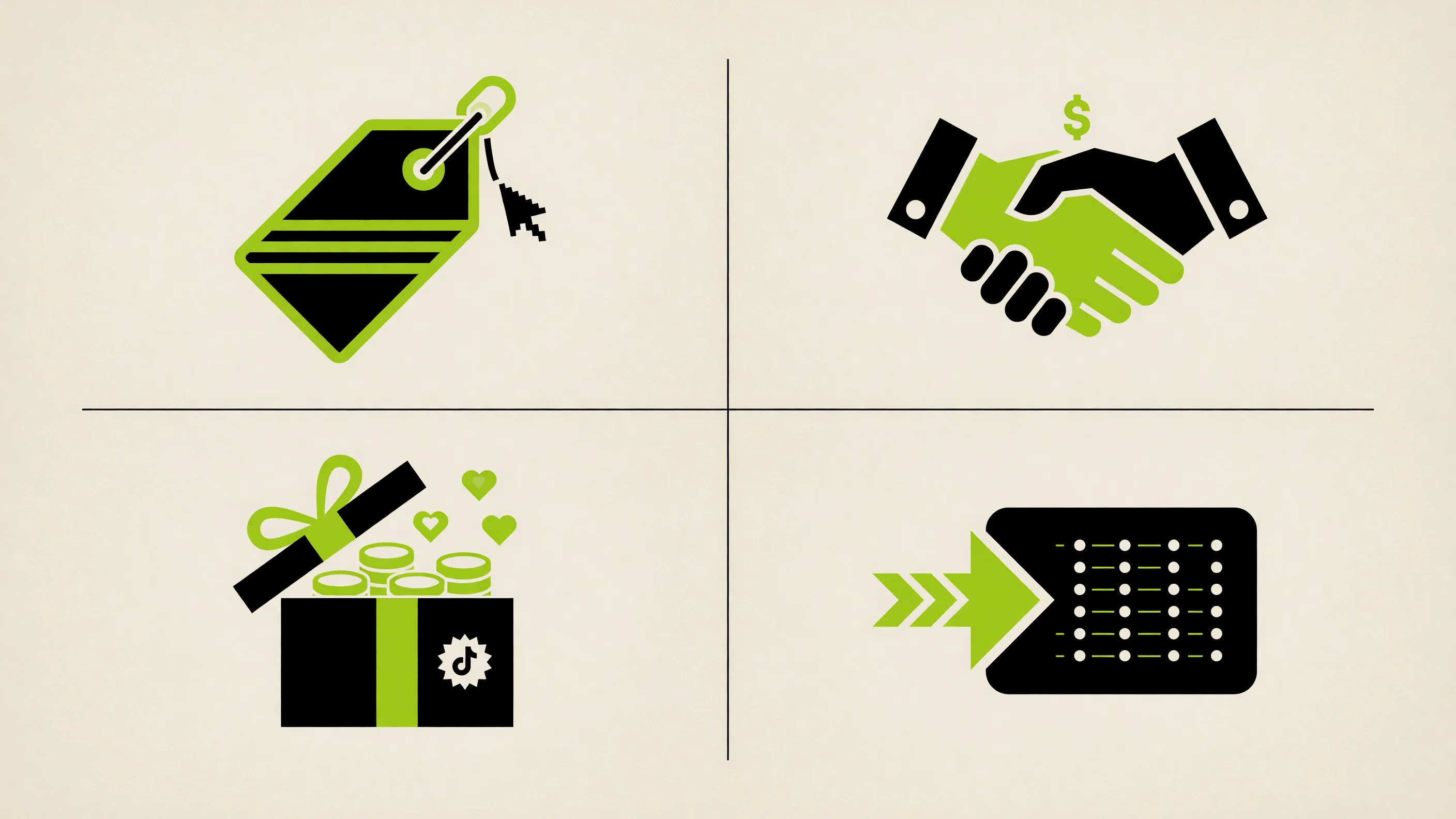
So if the reward program is off the table, where does slideshow income actually come from? The honest answer is that a slideshow page makes money the same way any content page makes money: by owning attention and pointing it somewhere valuable. TikTok is the distribution layer here, not the paycheck. For 2026, that mostly breaks down into four channels, and most successful pages run at least two of them at once rather than betting on a single one.
| Channel | How it works | Fit for slideshows |
|---|---|---|
| TikTok Shop affiliate | Tag products in posts, earn commission on sales through your link | Very strong, works directly inside the post |
| Brand deals / UGC | Paid to create sponsored slideshow posts for a brand | Strong once you have proof in a niche |
| Off-platform funnel | Link in bio to a newsletter, app, storefront, or community | Strong, the most durable channel long term |
| LIVE Gifts | Viewers send virtual gifts during a livestream | Weak, doesn't use the slideshow format at all |
Of those four, TikTok Shop affiliate is the closest thing to getting paid for slideshows that actually exists, and it's the one most worth setting up first if your page has any product angle at all, even a loose one. Brand deals scale better once you have proof, screenshots of views, saves, and click-through, and the off-platform funnel is the channel every faceless page should build from day one regardless of the other three, because it's the one TikTok can't change the rules on overnight.
This is also where a page's approach to hooks and captions starts to matter for revenue, not just growth. See our library of slideshow hook ideas for a running list of first-slide formats that keep viewers swiping into the caption or bio link, which is the exact moment monetization actually happens.
TikTok Shop affiliate commissions: the real math.
TikTok Shop's affiliate program lets any eligible creator tag a seller's product in a post or LIVE and earn a commission on anything sold through that link. Sellers set their own rate, not TikTok, and the platform technically allows anywhere from 1 to 80 percent, though in practice most categories land between 5 and 20 percent, occasionally up to 30 for high-margin or promotional items (TikTok Seller University, 2026). To join, a personal account currently needs roughly 5,000 followers, a creator must be 18 or older, and TikTok Shop must be live in their region.
Run the numbers on a mid-size faceless page. Say a slideshow gets 40,000 views, an ordinary number for a page with a consistent posting habit, and 1.5 percent of viewers tap through to the tagged product, a conservative click rate for a well-placed product slide. That's 600 clicks. If 4 percent of those convert at a $28 average order value with a 12 percent commission, the post nets roughly $80 to $100. Post daily and that adds up quickly, especially compounding with older slideshows that keep surfacing in TikTok search months after posting.
| Metric | Example value |
|---|---|
| Views | 40,000 |
| Click-through to product | 1.5% (600 clicks) |
| Conversion rate | 4% (24 sales) |
| Average order value | $28 |
| Commission rate | 12% |
| Estimated payout | ~$80-$100 |
Illustrative example built on typical TikTok Shop affiliate benchmarks (TikTok Seller University, 2026)
Payouts land roughly 15 days after order delivery for established sellers, longer, up to 31 days, for new sellers still in their settlement window, so treat this as a lagging channel rather than instant cash. One detail worth knowing: TikTok deducts the commission from the seller's payout automatically and routes it to you, so there's no invoicing anyone, the accounting happens entirely on TikTok's side.
Brand deals and link-in-bio funnels: the other income streams.
Brand deals work differently from affiliate commission because you're paid a flat or negotiated fee up front instead of a cut of sales, which makes them the highest-leverage channel once a page has real proof of reach. A niche page with consistent 50,000 to 200,000 view slideshows, screenshots of saves and shares, and a clean content history is a genuinely fundable asset to a small brand, even without a huge follower count, since brands buying UGC-style slideshow ads tend to care more about format fit and engagement than raw audience size.
The link-in-bio funnel is the least glamorous of the four channels and the most underrated. Every slideshow post is, in effect, a free ad for whatever sits behind your bio link, a paid newsletter, an app download, an affiliate storefront, or a paid community. It's also the channel least exposed to policy changes: if Creator Rewards requirements shift again, or TikTok Shop tightens payout terms in your market, an email list or app install you already converted doesn't disappear along with it.
I stopped waiting on Creator Rewards eligibility to show up and just put a product tag on every third slide. That was the whole shift.
kaelynn, Deeporax user
For an illustrative sense of scale, a pattern we've seen repeat across faceless pages we've studied: a page in the home organization niche posts daily, none of it eligible for Creator Rewards since none of it is video, and the account still nets roughly $600 to $900 a month once TikTok Shop tags and two recurring brand partnerships sit on top of a link-in-bio product page. No single post makes that number; the volume and repetition across a full month does.
LIVE Gifts, Series, and Pulse: do any of them fit a slideshow page.
TikTok runs several monetization programs beyond Creator Rewards, and it's worth being clear about which ones a slideshow-only page can actually use. LIVE Gifts let viewers send virtual gifts during a livestream that convert to real payouts, and the bar to turn it on is comparatively low, roughly 1,000 followers, plus being 18 or older to receive gifts (16 to go live at all, 19 in South Korea specifically). The catch is obvious: it requires an actual live broadcast, not a slideshow, making it a separate content habit layered on top rather than a slideshow monetization path.
TikTok Series, a paid content tier with roughly a 10,000-follower requirement, and Pulse, ad-revenue sharing on top creators' videos with around a 100,000-follower bar, both require video by design and don't apply to Photo Mode posts at all. TikTok One, the platform's creator marketplace connecting brands to creators, is more format-agnostic, and slideshow pages have used it to land brand deal work, folding back into the brand-deal channel already covered above.
The practical takeaway: of TikTok's full lineup of official programs, TikTok Shop is the only one built to work natively with a slideshow's actual format. Everything else either excludes photo content outright or asks you to add a content type, live video, that isn't what a slideshow page is built around.
The real numbers: what a slideshow account can actually earn.

It helps to see the spread side by side, because does TikTok pay for slideshows is really a question about opportunity cost. A comparable video-first account and a slideshow-first account, both posting daily with similar view counts, end up earning through completely different mechanisms, and neither number is objectively bigger, they're just structured differently.
| Monthly For You views | Video account (Creator Rewards only) | Slideshow account (Shop + deals + funnel) |
|---|---|---|
| 100,000 | ~$40-$100 | ~$50-$150 |
| 500,000 | ~$200-$500 | ~$300-$800 |
| 2,000,000 | ~$800-$2,000 | ~$1,500-$4,000+ (brand deals scale non-linearly) |
Estimated ranges synthesized from Creator Rewards Program payout benchmarks (Influencer Marketing Hub, 2026; Demandsage, 2026) and typical TikTok Shop affiliate and brand-deal patterns. Individual results vary widely by niche and audience quality.
Two things stand out. First, the video-only column caps out at whatever the RPM formula pays, full stop, there's no channel to layer on top of it beyond going live separately. Second, the slideshow column's range gets wider, not narrower, at scale, because brand deal pricing doesn't follow a linear per-view formula the way ad revenue does. A page with 2 million monthly views and strong saves can often negotiate a single sponsored post worth more than its entire month of affiliate commission combined.
The trend over the last several years backs this up structurally. TikTok Shop barely existed for most creators before 2023, brand deal budgets for short-form UGC have grown every year since, and the Creator Rewards Program itself replaced a Creator Fund widely considered too small to build a real business on. The direction of travel favors diversified, product-adjacent slideshow pages more than it favors chasing a single per-view rate.
Should you switch to video, or stay slideshow-only.
This is the real decision buried inside does TikTok pay for slideshows, and it deserves an honest answer rather than a pitch either way. If the goal is specifically Creator Rewards Program income, slideshows cannot get you there, full stop, and no workaround changes that. If the goal is income in general, format is a means, not the goal, and the right call depends on what you're already good at producing.
| Factor | Favors video | Favors slideshow |
|---|---|---|
| Production time per post | Higher: filming, editing, voiceover | Lower: source images, layout, caption |
| Direct TikTok payout | Yes, Creator Rewards eligible | No |
| TikTok Shop affiliate fit | Works, slower to tag mid-video | Very strong, tag directly on a slide |
| Faceless, anonymous operation | Harder, usually needs voice or presence | Easy, no camera or voice required |
| Scales across multiple pages | Harder, each video is a real production | Easier, one team can run several pages |
For more on this exact tradeoff, our comparison of slideshows versus videos goes deeper into production cost, watch-time behavior, and which format tends to win for a given niche. The short version for monetization specifically: a lot of the highest-earning faceless operators run both, using slideshows for volume, search reach, and TikTok Shop income, and reserving a smaller number of longer videos purely to stay eligible for Creator Rewards on the side.
If you do add video, know what you're opting into: TikTok's originality and quality standards get stricter, not looser, and content that reads as templated or AI-assisted without disclosure risks a flag under the platform's evolving AI content rules, a separate issue worth understanding before you scale either format.
A 30-day plan to monetize your slideshow page.
None of this requires starting from zero. If a slideshow page is already posting with some consistency, here's a realistic month to go from posting into the void to having at least one live income channel running.
| Week | Focus | Action |
|---|---|---|
| Week 1 | Foundation | Apply for the TikTok Shop Affiliate Program (5,000 followers minimum) and shortlist 2-3 products that fit your niche naturally |
| Week 2 | Consistency | Automate the posting cadence so the account keeps shipping daily without manual work |
| Week 3 | Retention | Rebuild the hook pool so the first slide earns the swipe every time |
| Week 4 | Compounding | Send one brand outreach message using your best post as proof, and set up an off-platform link behind your bio |
Two things run underneath this plan and are worth doing in parallel rather than after the fact. For the automation piece in Week 2, our guide on how to automate TikTok slideshows with AI covers the full posting pipeline, and the hook rebuild in Week 3 pairs directly with the library in 100+ slideshow hook ideas.
If the account is new or has had a rocky posting history, spend real time on account health before pushing volume; our guide on how to warm up a TikTok account covers the sequence that keeps a fresh account out of restriction limbo. It's also worth watching how content gets found in the first place: TikTok increasingly surfaces slideshows through search rather than just the For You Page, which is exactly what our companion piece on TikTok SEO for slideshows walks through.
If any part of the pipeline leans on AI-generated images, voiceovers, or scripting, true for most faceless slideshow operations at this point, it's worth reading our breakdown of TikTok's AI content policy for creators before scaling posting volume, since disclosure and detection rules have shifted enough in 2026 that what worked last year isn't a reliable guide anymore.
This is also the exact gap Deeporax is built to close: sourcing images, writing the hook, laying out the slides, and publishing on schedule, so the automate-posting and rebuild-the-hook-pool steps above happen without anyone doing them by hand every day. The features page walks through the full pipeline, the tools directory covers what ships today, and pricing has the plan breakdown if you want to see where a page like yours would land.
Frequently asked questions.
Does TikTok pay for slideshows?+
No. TikTok's Creator Rewards Program only pays for original videos over one minute long with at least 1,000 qualified For You feed views. Photo Mode and slideshow posts are explicitly excluded, though they can still earn through TikTok Shop affiliate links, brand deals, and off-platform traffic.
Do photos qualify for the TikTok Creator Fund?+
No, and this hasn't changed since the Creator Fund was replaced by the Creator Rewards Program. Neither the old Creator Fund nor its replacement has ever paid out for photo or slideshow content; both have always required original video.
Can I make a slideshow for the Creator Rewards Program?+
You can post one, but it won't be eligible for a payout no matter how many views it gets. TikTok's criteria require video content over one minute, and Photo Mode posts don't meet that definition.
Does the Creator Fund still exist in 2026?+
Not under that name in most major markets. TikTok discontinued it in the US, UK, Germany, and France in late 2023 and migrated eligible creators into the Creator Rewards Program, which pays a meaningfully higher rate per 1,000 views.
Why isn't my slideshow earning Creator Rewards money?+
Because it structurally can't, not because anything is broken on your account. Your Creator Rewards Program tab will likely only surface eligible video content at all; slideshow posts aren't evaluated for that payout regardless of performance.
How do I actually make money from a TikTok slideshow page?+
Set up TikTok Shop affiliate tagging first, since it's the closest thing to native slideshow monetization, then add brand deals once you have proof of consistent views and saves, and build an off-platform funnel behind your bio link so income doesn't depend entirely on TikTok's rules staying the same.
What's the minimum follower count to join TikTok Shop's affiliate program?+
Around 5,000 followers on a personal account, plus being 18 or older with TikTok Shop available in your region. Sellers set their own commission rate, typically 5 to 20 percent depending on the category.
How much does TikTok actually pay per 1,000 views in 2026?+
For eligible video in the Creator Rewards Program, commonly reported rates run about $0.40 to $1.00 or more per 1,000 qualified views. That rate applies only to qualifying video; there's no equivalent per-view rate for slideshows since they aren't part of that program.
How do I get brand deals for a faceless slideshow page?+
Build a portfolio of your best posts with view, save, and share screenshots, pick a specific niche, and reach out to small and mid-size brands directly or through TikTok's creator marketplace once eligible. Brands buying UGC-style slideshow ads usually care more about engagement and format fit than raw follower count.
Can I combine slideshows and videos on the same account for monetization?+
Yes. Many of the highest-earning faceless accounts run slideshows for daily volume, search reach, and TikTok Shop income, plus a smaller number of longer videos specifically to stay eligible for Creator Rewards payouts on the side.
Why did my slideshow get flagged for unoriginal content if it can't earn Creator Rewards anyway?+
TikTok's originality and quality policies apply account-wide, not just to Creator Rewards eligibility. A flag can still hurt distribution on that post even though it was never eligible for a payout, so treat originality flags seriously regardless of format.
I converted my slideshow into a video file. Does that make it eligible?+
No. TikTok's systems evaluate the actual content, not the file wrapper, and slide videos, static images stitched together and exported as a video, are explicitly named in TikTok's quality guidelines as ineligible, the same as a native Photo Mode post.
My TikTok Shop affiliate commission hasn't arrived yet. Is that normal?+
Usually yes. Standard sellers settle roughly 15 days after order delivery, while new sellers can take up to 31 days. If a payout runs significantly later than that, check the specific seller's settlement terms rather than assuming the program is broken.
Does TikTok Shop work with slideshow posts specifically?+
Yes, and it's one of the strongest use cases for the format. You can tag a product directly on a slide, letting a viewer act on the recommendation without leaving the post, something a fast-moving video often gives less time to do.
Is it better to post videos or slideshows if my main goal is Creator Rewards income?+
Video, without question, since slideshows are categorically excluded from that program. But if the actual goal is income in general, slideshows paired with TikTok Shop and brand deals frequently out-earn a Creator Rewards-only video strategy, especially for accounts without the capacity to post video daily.
Sources.
- TikTok Creator Academy, Creator Rewards Program: How to Qualify and Enroll (2026)
- TikTok Creator Academy: Join the TikTok Creator Rewards Program (2026)
- TikTok Legal: Creator Rewards Program Terms (US)
- TikTok Legal: Rewards Policy
- TikTok Creator Academy: Understanding TikTok's Originality Policy
- TikTok Seller University: Creator Eligibility Policy
- TikTok Seller University: How Standard Affiliate Commission Works
- TikTok Support: TikTok Creator Fund (legacy program)
- Metricool: TikTok Rewards Program vs. TikTok Creator Fund (2026)
- Fourthwall: Is TikTok's Creator Rewards Program Worth the Payout? (2026)
- Influencer Marketing Hub: How Much Does TikTok Pay in 2026?
- Demandsage: How Much Does TikTok Pay In 2026?
- Elev8or: TikTok Creator Rewards Program Eligibility 2026 Guide
- Stack Influence: How Many Followers on TikTok to Go Live in 2026
- Social Champ: How To Turn On TikTok Gifts: Requirements & Setup (2026)
- Hamster Garage: TikTok Shop Affiliate Commission: 2026 Rates, Fees & Payouts
- TechCrunch: TikTok says its revamped Creator Fund has increased total creator revenue by over 250% (2024)
- OpenClip: Do TikTok Slideshows Make Money? The Honest Math
- Deeporax inspiration database (2026)
Written by
Deeporax Team
Field notes from the team building Deeporax, written from live account data across thousands of faceless TikTok pages.